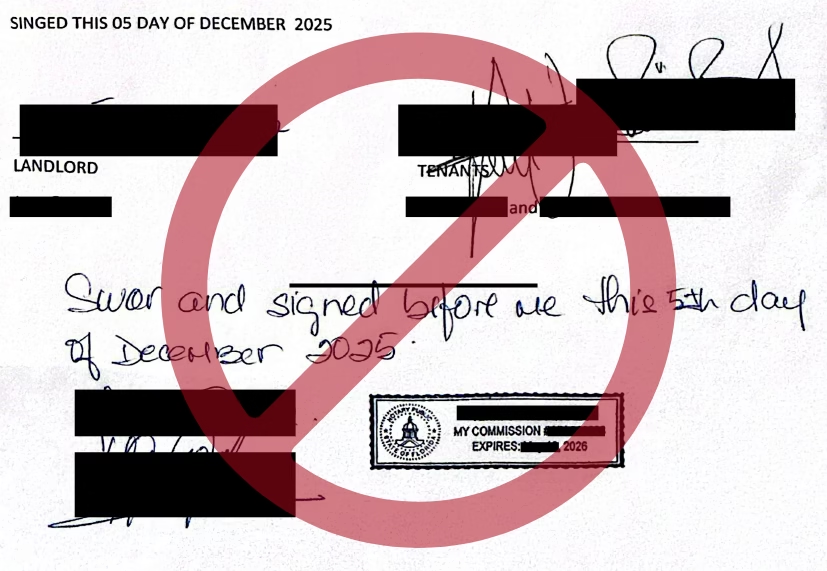
A client came to me recently to incorporate his business in Florida and get guidance on setting up his new commercial shop. He is investing real money—construction, supplies, signage, a full build-out. He signed a lease with a landlord and a second partner. Everything looked routine until I reviewed the notarized signature page. That page told a different story—one careless notarial act strong enough to jeopardize the entire agreement.
The document had three signatures: one landlord, two tenants. The notarial certificate was handwritten, crossed out, improvised, and missing essential elements required under Florida law. It was the kind of certificate that looks more like a note passed in a classroom than a sworn declaration attached to a commercial lease. The notary’s commission expires in 2026, which means she received her commission in 2022. Two full years in this profession, and still unable to complete the most basic certificate language.
Commercial leases are not a joke. They rely on clarity, enforceability, and proper execution. A defective certificate is more than sloppy paperwork—it can undermine the conditions of the agreement. My client trusted a notary to protect the integrity of his investment. Instead, the notarization created doubt where certainty is mandatory.
Florida’s notary system enables this. The state has extremely low entry requirements. You complete a short online “education” module, take a surface-level test, submit paperwork, and the commission arrives. There is no supervised training, no practical exam, no ongoing evaluation. A person can move from zero legal understanding to stamping legal instruments in a few hours.
That casual approach produces predictable results—people authorized to notarize contracts, affidavits, acknowledgments, and jurats without understanding what those acts mean.
A proper Florida certificate must, at minimum, identify the type of act performed, the venue, the exact names of the signers, and the date. It must state whether the signer swore or acknowledged. Those are not optional elements. They are statutory requirements. Leaving them out opens the door to challenges.
In a commercial context, that can trigger delays or disputes. A landlord can claim the agreement was never properly executed. A bank financing a build-out may question compliance. An attorney reviewing the file may refuse to rely on it. In short—uncertainty where certainty is expected.
This is exactly what notarization is designed to prevent. A notary exists to reinforce trust: confirming identity, willingness, awareness, and legality. The notarial certificate is the legal instrument that tells third parties, “This signature is reliable.” When the certificate is improvised, unclear, or incomplete, that assurance collapses.
My client did everything right. He paid his fees, signed his agreement, prepared to open his business, and relied on the notary to anchor the transaction. Instead, the person holding the stamp created exposure, not protection.
Florida needs stronger standards. A system that approves thousands of notaries without practical oversight creates more risk than security. The public assumes a commissioned notary represents competence. Too often, the commission represents nothing more than a completed online form.
A better approach would include:
• A meaningful exam that tests real-world scenarios, not memorized quiz answers
• Mandatory practical training, including sample certificates, acknowledgments, and jurats
This is not an unrealistic expectation. Other professions—real estate, mortgage origination, insurance adjusting—require stronger preparation because their work affects money, property, and rights. Notarization affects all three.
And the public is the one exposed. Small business owners trying to open a shop are risking capital, time, and credit. They need enforceable agreements, not handwritten improvisations.
When a notary fails to follow statutory language, the notarization can be challenged. When a notarization is challenged, the agreement attached to it can be slowed down, renegotiated, or voided. That means lost time, lost leverage, and sometimes lost money.
Florida’s legislature has allowed the notary profession to become a low-stakes license in a high-stakes environment. The stamp grants authority, but the state does not require skill. That combination puts business transactions at risk.
People deserve more. They deserve notaries who can complete a certificate without improvisation. They deserve a system that treats legal authentication as a responsibility—not a side hobby.
My client walked into that signing believing he was protected. He walked out with a defective certificate that could damage his position. That should not happen—not in a state that records property, enforces contracts, and encourages business formation.
If Florida wants notarization to matter, it must raise the bar. Until then, business owners must protect themselves by choosing notaries who understand the law—not just those who own a stamp.